Mortgage Options for Self-Employed Buyers in Middle Tennessee
A practical guide to documenting income, comparing mortgage options, and preparing a stronger application.

Being self-employed has advantages — flexibility, independence, and control. But when it comes to getting a mortgage, it can feel like lenders are asking for the moon: “Where are your W-2s?” “Your income is too variable.” “We need more tax returns.”
Here is the reality: self-employed home buyers in Middle Tennessee have options. Several loan programs are designed to work with income that does not fit the traditional W-2 mold. Requirements depend on the borrower, the property, the lender, the loan program, the documentation available, underwriting, and current guidelines — so the goal of this guide is to explain how the options differ and how to prepare, not to promise an outcome.
This guide covers mortgage programs that may work for freelancers, gig workers, business owners, and independent contractors in Middle Tennessee, and how to get organized before you apply.
Why Self-Employment Complicates a Mortgage
Traditional lenders like predictability. A W-2 employee has a clear paper trail: recent pay stubs, consistent income, and employer verification. Self-employed income is messier. Earnings can vary from year to year, business expenses are written off, and a tax return shows profit after deductions rather than gross receipts.
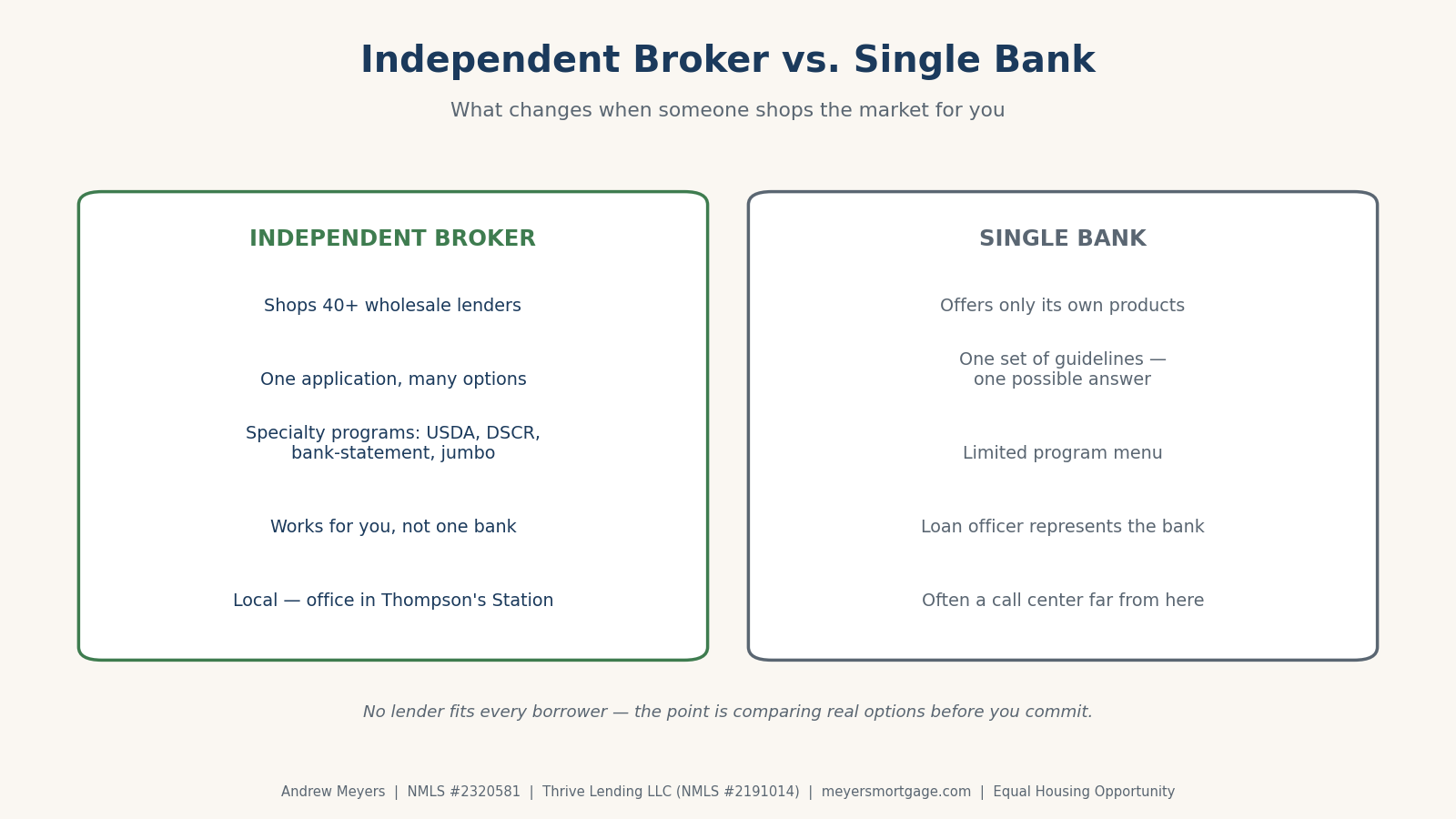
Some lenders simply prefer not to work with self-employed borrowers because the income takes more work to verify. That is the first hurdle: finding lenders and programs that are set up for self-employed income. As an independent broker with Thrive Lending LLC, I work with multiple wholesale lenders, some of which specialize in exactly this.
Your Mortgage Options as a Self-Employed Buyer
Option 1: Bank-Statement Loans
How it works: Instead of tax returns, the lender reviews a period of personal or business bank statements to establish income from actual deposits. A bank-statement loan is a non-QM program offered by a subset of lenders, and the specifics — how many months of statements, how deposits are counted, and what expense factor is applied — vary by lender.
Who it may fit: Freelancers and gig workers, business owners who take irregular distributions, and borrowers whose tax returns do not reflect their actual cash flow.
Trade-offs: Down payment requirements are generally higher than for conventional or FHA loans, fewer lenders offer these programs, and pricing is typically different from conventional financing. Credit, reserve, and documentation requirements are set by each lender and can change.
Option 2: Conventional Loans With Self-Employed Income
How it works: A conventional loan that documents self-employed income through personal and business tax returns, a year-to-date profit-and-loss statement, and bank statements. Income is calculated from the returns, and certain deductions such as depreciation may be added back under current guidelines.
Who it may fit: Established business owners — sole proprietors, LLC members, and S-corp owners — who are comfortable providing detailed documentation. Most guidelines look for a history of self-employment; how much history is required depends on the program and your overall profile.
Trade-offs: Income verification takes more time and paperwork than a W-2 file, and the income calculation can be conservative. In exchange, it is a mainstream program with broad lender availability.
Option 3: FHA Loans for Self-Employed Borrowers
How it works: FHA loans accept self-employed borrowers under FHA guidelines. You will typically provide tax returns, bank statements, and business documentation, and sometimes a CPA letter. FHA allows a lower minimum down payment than many other programs for eligible borrowers and is generally more flexible on credit, but it carries mortgage insurance premiums, and how long that insurance lasts depends on the loan terms. If you are buying in Maury County, our guide to first-time home buyer programs in Columbia, TN explains how FHA compares with USDA, VA, and conventional options.
Who it may fit: First-time buyers who are self-employed, and borrowers with limited down payment savings.
Trade-offs: Mortgage insurance adds to the monthly cost, and FHA’s income calculation for self-employed borrowers is generally conservative.
Option 4: USDA Loans (When the Property and Borrower Qualify)
How it works: USDA loans can allow eligible borrowers to buy with no down payment. Self-employed income is documented much like a conventional loan, with tax returns and bank statements. USDA eligibility depends on the exact property address and the current USDA eligibility map, household income limits, owner-occupancy, property requirements, underwriting, and current guidelines. No road, subdivision, town, county, or area is eligible as a whole; each address has to be checked.
Who it may fit: Buyers looking at less-developed parts of Middle Tennessee whose household income is within the limit for the county.
Trade-offs: The address has to qualify, household income is capped, and the property has to meet USDA standards.
How Self-Employed Income Is Calculated
This is where you need to pay attention, because different programs calculate income differently:
- Bank-statement loans: income is derived from deposits over the review period, using the lender’s method and expense factor.
- Conventional: income is calculated from tax-return net profit, with certain add-backs allowed under current guidelines.
- FHA: uses tax-return net profit with limited add-backs, generally the more conservative approach.
- USDA: similar to conventional, using tax-return net profit plus allowable adjustments, subject to household income limits.
Key point: the same business can produce a different qualifying income under different programs and lenders. That is where access to multiple wholesale lenders matters — the right fit depends on your file.
Common Self-Employed Situations
My business had a loss year. Can I still qualify? Possibly. Bank-statement programs focus on current deposits rather than tax-return profit. Conventional and FHA programs will look at why the loss happened and whether current income is stable. Be ready to explain it.
I’m a 1099 contractor. Do I qualify? Many programs work with 1099 income. Keeping business deposits in a separate business account makes documentation cleaner.
I pay myself inconsistently. How do I prove income? Bank-statement programs look at what actually flows into your accounts; conventional and FHA programs rely on tax returns. Which one fits depends on your records.
My CPA recommended taking a loss for tax purposes. Will that hurt? It can, if you are relying on tax-return income. If you plan to buy within the next year or two, talk with your lender before you file so you understand the trade-off.
I recently went from W-2 to self-employed. Can I get a mortgage? It depends on the program and how long you have been self-employed. Some guidelines consider prior experience in the same line of work. This is a case-by-case review.
Credit, Down Payment, and Reserves
Self-employment itself does not set a different credit-score threshold. Minimum credit, down payment, reserve, and debt-to-income requirements are set by each program and lender and can change. Stronger credit, a larger down payment, and cash reserves generally broaden your options and can affect pricing, but no single number guarantees approval.
Documents You’ll Need (Self-Employed Checklist)
Having these ready before you apply saves time:
- Photo ID
- Recent personal bank statements
- Personal tax returns for the years your lender requests
- Business tax returns, if applicable (Schedule C, 1120-S, 1120, K-1, and so on)
- Business bank statements, kept separate from personal accounts
- A current-year profit-and-loss statement if applying mid-year
- Business license, EIN documentation, or other proof the business is active
Bank-statement programs may not require business tax returns; conventional and FHA programs generally do. Your lender will confirm the exact list for your program.
How the Process Typically Works
A self-employed mortgage follows the same broad steps as any other: a conversation about your business and goals, a credit review and income analysis, a pre-approval, an offer on a home, appraisal and title work, underwriting, and closing. Self-employed files usually need more documentation and can take longer in underwriting. How long each step takes depends on the lender, the program, the appraisal, how quickly documents come in, and the specifics of your file — so plan for flexibility rather than a fixed date.
Mistakes Self-Employed Buyers Make
- Mixing business and personal finances. Separate accounts make income easier to verify.
- Large, unexplained deposits. Lenders will ask about them; keep a paper trail.
- Filing a strategic loss right before applying. Talk to your lender and CPA about timing.
- Changing business structure or opening new accounts right before applying. Consistency helps.
- Assuming you will not qualify and never asking. A review costs nothing and clarifies your options.
How an Independent Broker Helps
As a broker with Thrive Lending LLC, I compare programs across multiple wholesale lenders rather than one bank’s product line. For self-employed borrowers that matters, because lenders differ in which programs they offer and how they calculate income. My job is to match your file to the program that fits and to tell you plainly if now is not the right time.
Ready to Review Your Options?
Self-employed does not mean unqualifiable — it means different documentation. Gather the checklist above, then call or text (541) 632-0920 or email ameyers@thrivelending.us for a no-obligation conversation about your business, your timeline, and which programs may fit.
This article is for informational purposes only. Mortgage eligibility for self-employed borrowers depends on the borrower, property, lender, loan program, documentation, underwriting, and current guidelines.